Erhard Schulte, a well-known expert on Trakehner breeding, gave a lecture at the VZAP members’ meeting on the value of Arabian blood in Trakehner breeding, with a special focus on Arabian mare families. To ensure everyone can participate, a transcript of this lecture is available here.
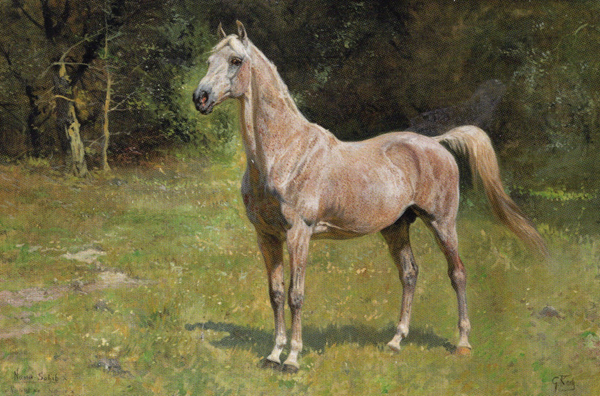
The Anglo-Arabian stallion Nana Sahib x, painting by Georg Koch
The Trakehner breed has been closely linked to Arabian blood since its inception. Friedrich Wilhelm von Burgsdorf, one of the greatest masters of the Trakehnen horse stables, was particularly fond of Arabian blood. He sent his ambassadors throughout the Orient to bring Arabian mares and stallions to Trakehnen. Among them was the mare Fatme, who was introduced to the famous mixed-blood herd in Bajohrgallen in 1795. It is known that she was born in 1787, but no evidence of her lineage exists. She was presumably a desert mare, purchased from Bedouins. According to the old stud books, Fatme was a particularly noble, particularly noble mare with great movements, as they said at the time. She founded her line through her daughter Penelope, by a purebred Arabian named Delue. I begin this talk with Fatme because she founded a mare family in Trakehnen that remains very vital and active to this day, known as the “T14 Family (Trakehnen Main Stud).”
In Trakehner breeding alone, we have 15 independent mare families that trace their origins back to Fatme in various branches. This is something very special, as this line began with this mare in the founding days of Trakehner breeding and continued into the heyday of Trakehnen. Fatme didn’t last long, but at least through her daughter Penelope, born in 1797, the line continued. In 1801, she was introduced into the black herd in Gurdszen, where she was primarily active. There she founded the magnificent families of Herbstzeit, Halensee, Handschelle (from the Chamber of Commerce), and so on. This mixed-color herd was the bastion of Arabian blood in Trakehnen.
Anglo-Arabians from France
In Bajohrgallen, there was also a herd of mares with Arabian influences and mares with high bloodlines. Among them were the four grey mares from Weil-Marbach in the early 1930s: Dongola ox, Khasa ox, Czeska ox, and Glaukopis ox. These four mares, including three Jasir daughters, were the first to join this herd, which consisted of pure Arabian mares, half-Arabian mares, or mares with high bloodlines. Stallions from Europe, such as the French Anglo-Arabian Nana Sahib x, were brought into this herd to further strengthen this bloodline. It was not for nothing that Trakehner horses were considered the ‘German Anglo-Arabians’ at the time.
But back to Nana Sahib x: He was born in France; his sire was an English Thoroughbred, and his grandmother was an Arabian mare from the purest Arabian desert springs. This stallion was the most successful steeplechaser in France for three years. He earned thousands of francs in winnings before being acquired for Trakehnen by Burchard von Oettingen, also one of the great masters of the state stables. This Nana Sahib set a precedent in terms of horse vitality, performance, and health, and not only the Trakehner breed benefited from him for generations. He lived to be 29 years old, despite his successful sporting career at a young age. Nana Sahib x was very well used and was a phenomenal show jumper, which is underscored by the following story: In Trakehnen, there was a pack – the Trakehner hunts behind the pack were world-famous. When Nana Sahib was in his paddock – the stallions all had wonderful grass paddocks – and the pack was being exercised, then of course it couldn’t have happened without Nana Sahib! He jumped over the 1.80-meter-high paddock wall to join the pack—so the wall had to be raised to 2 meters. The stallion was truly a phenomenon in this regard, and he passed on this jumping ability. Back then, Trakehner horses won the show jumping derbies in Hamburg, such as Morgenglanz, a son of Nana Sahib x Monogamie von Lauer, naturally bred into the mixed-color herd in Bajohrgallen. He won the 1930 German Show Jumping Derby and was one of the most successful show jumpers in the world at the time. There was another of this blood: Nanuk by Cornelius. This Cornelius was also a Nana Sahib son out of Canone by Piper. With Nanuk, born in Graditz from a pure Trakehner mare, Irmgard von Opel became the first woman to win the Hamburg Derby in 1934.
The rest of this article is only visible to Online Subscribers.
Please log-in, if you are already an Online-Subscriber: Login-PagePlease go to the Shop, if you want to become an Online-Subscriber: Shop-page
The one-year Online Subscription is available at 20 €
-------------------------------------------------------------------------------------------------